Showing posts with label Virus On Disk. Show all posts

Sunday, November 22, 2009

How to prevent your PEN drive from VIRUS

Friends many of your PC/laptop's normally gets virus because of Pen Drives or USB devices (Even PC's who are not connected to network ). Some Virus like Ravmon Virus , Heap41a worm which are not detected by anti virus normally spreads mostly by the Pen Drives . In such a case what can you do to prevent your PC from getting infected with Virus that spreads through USB devices or Pen Drives ?

You can protect your PC by just following the simple steps below . It won't take much time.

· Connect your Pen Drive or USB drive to your computer .

· Now a dialogue window will popup asking you to choose among the options as shown
in the figure. Don't choose any of them , Just simply click Cancel.

Sunday, November 15, 2009

Download Free McAfee VirusScan Enterprise

McAfee VirusScan Enterprise protects your desktop and file servers from a wide range of threats, including viruses, worms, Trojan horses, and potentially unwanted code and programs.

This version provides these new or improved features:
- Support for 64-bit operating systems.
These features or products are not supported on
64-bit operating systems:

- Buffer Overflow Protection.
- Scanning of Lotus Notes databases.
- Alert Manager 4.7.1.

Saturday, November 14, 2009

Protect Computer Offline With USB Disk Security

USB Disk Security provides 100% protection against any threats via USB drive, however, the majority of other products are unable even to guarantee 90% protection. USB Disk Security is the best antivirus software to permanently protect offline computer without the need for signature updates, but other antivirus software should update signature database regularly, and they cannot effectively protect offline computer. This light and easy to use solution is 100% compatible with all software and doesn't slow down your computer at all. You pay USB Disk Security once and get it all, however, other antivirus products should be paid for updates every year.

Product Highlights:

100% protection against any malicious programs via USB storage

Tuesday, November 10, 2009

How to identify and Avoid the USB drive affected with virus

Virus and worms are easily spread by carrying it on a removable medium such as ,USB drive , I-Pod, CD, Floppy. USB drive is otherwise called as “Flash Drive”,”Thumb Drive” ,”Memory stick” ,”External USB Hard Disk”. Even though we have very good Antivirus , New Viruses are one step Ahead than Antivirus. We cannot restrict USB Drive , but we can avoid spreading of virus and worms through USB Drive. So we have to be little bit careful while working with USB Drive, some precautionary steps are follows.

How to identify the USB drive affected with virus

After Inserted USB drive

This screen shot shows the USB drive which is affected with virus

Wednesday, November 4, 2009

Tips How to Virus Recovery

Why is a computer virus harmful? For the same basic reason that biological viruses are: they damage components that keep systems healthy. Some are relatively benign - they generate annoying, juvenile messages or crash the system once, then go away. But many are specifically designed to do substantial harm - by deleting files needed to run word processing programs or perform essential operating system tasks. Some prepare the way for further attacks by opening up access to administrative functions.

Combating them is simple - install antivirus software, keep it up-to-date and running in the background and don't open email attachments from unknown sources. Nonetheless, odds are high that someday the system will be infected. Important data will be lost, essential program and operating system files will be zapped. Now what?
First thing: Don't panic. You may not even be infected. Before implementing a cure you have to diagnose properly.

Wednesday, October 28, 2009

The Most Important Facts about net Security

WHAT IS A VIRUS?
A computer virus is a computer program that can copy itself and infect a computer without permission or knowledge of the user. Computer Viruses have been a problem for many years. When people speak of computer viruses they often mistake Spyware for being a virus, when in fact most computer viruses are hidden and not out in the open like a spyware infection.

A Virus can be introduced to a computer through many different ways. They can be attached to an email, hidden in a CD-ROM or USB drive, installed unknowingly when installing supposedly legitimate software, through a network from another infected
computer, and through unsafe surfing with an un-patched computer.

Among the things that a Computer Virus can do damage to, are a persons files system files, and boot files. Or a virus could do nothing at all other than replicate itself and spread to other computers.

Tuesday, October 20, 2009

How do I keep myself safe from viruses?

Sometimes, typically via email, viruses (or virii) are able to cross the wall and end up on your computer anyway. A virus scanner will locate and remove them from your hard disk. A real time virus scanner will notice them as they arrive, even before they hit the disk, but at the cost of slowing down your machine a little.

Important: because new virii are arriving every day, it's important to keep your virus definitions up-to-date. Be sure to enable the scanning software's automatic-update feature and have it do so every day.

Virus - Autorun.inf And What Alternative

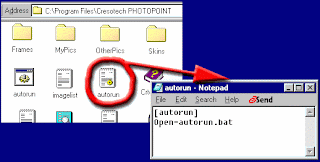
Autorun can pose a security threat, when the user does not expect or intend to run the software, such as in the case of some viruses, which take advantage of this feature to propagate, especially on USB FLASH DRIVES.

For instance, an attacker with brief and casual physical access to a computer can surreptitiously insert a disc and cause software to run. Alternately, malicious software can be distributed with a disc that the user doesn't expect to contain software at all -- such as an audio compact disc. Even music CDs from well known name-brand labels have not always been safe.

There is a way to disable on-click autorun, although this method disables it both for CD/DVD disks (where it can be useful sometimes) and for USB flash drives (where it is almost nothing but a security threat).

An alternative, available from Windows 2000/XP, is to use the group editor to turn off autorun / autoplay for both insertion and Explorer's "on-click" / double-click handling of data CD/DVD's.

1. Start -> Run -> gpedit.msc
2. Computer Configuration -> Administrative Template -> System
3. Double click subkey "Turn off Autoplay" and enable it.

(Tany)

Virus - CIH (1998)

Chernobyl virus also known as CIH was first detected in 1998, however, it first triggered in April 1999, 13th the anniversary of the Chernobyl nuclear disaster (which took place in Ukrainian). 

One of the most harmful viruses, it overwrites critical information on infected system drives. The virus was reportedly the first virus known to have the power to damage computer hardware, with virus attempting to erase the hard drive and overwrite the system's BIOS as well. 

The virus is also known as "space filler virus," due to its ability to clandestinely take up file space on computers and prevent anti-virus software from running. The malicious programme caused widespread damage in several Asian countries paralyzing thousands of computers. 


Virus - Brain (1986)

`Brain' was the first virus to hit computers running Microsoft's then popular operating system DOS. The virus was written by two Pakistani brothers, Basit Farooq Alvi and his brother Amjad Farooq Alvi and left the phone number of their computer repair shop. 

A boot-sector virus, Brain infected the boot records of 360K floppy disks. The virus would fill unused space on the floppy disk so that it could not be used. The first "stealth" virus, it hid itself from any detection by disguising the infected space on the disk. Due to its partial non-destructiveness, Brain often went undetected as many times users paid little attention to the slow speed of floppy disk access.

The virus was also known as Lahore, Pakistani and Pakistani Brain. BusinessWeek magazine called the virus the Pakistani flu. The brothers told TIME magazine they had written it to protect their medical software from piracy and it was supposed to target copyright infringers only.

Virus - Elk Cloner (1982)

Regarded as the first virus to hit personal computers worldwide, "Elk Cloner" spread through Apple II floppy disks. The programme was authored by Rich Skrenta, a ninth-grade student then, who wanted to play a joke on his schoolmates. 

The virus was put on a gaming disk, which could be used 49 times. On 50th time, instead of starting the game, it opened a blank screen that read a poem: "It will get on all your disks. It will infiltrate your chips. Yes it's Cloner! It will stick to you like glue. It will modify RAM too. Send in the Cloner!" The computer would then be infected. 

Elk Cloner was though a self-replicating virus like most other viruses, it bore little resemblance to the malicious programmes of today.